Cultural Education and Dialogue in Memmingen
Cultural Education & Societal Discourse in Memmingen: Outlook on Upcoming Formats (from 2027)
How can cultural education in Memmingen become an even stronger engine for democratic dialogue in the coming years? This article compiles planned and likely developments for public cultural venues, participation formats, and urban space projects – with a focus on future events and program lines.
Target group: Citizens, families, youth, educational partners (schools/clubs), and those interested in culture who want to learn about upcoming participation and educational opportunities in Memmingen.
Cultural Education in Public Institutions: Planned Focus Areas from 2027
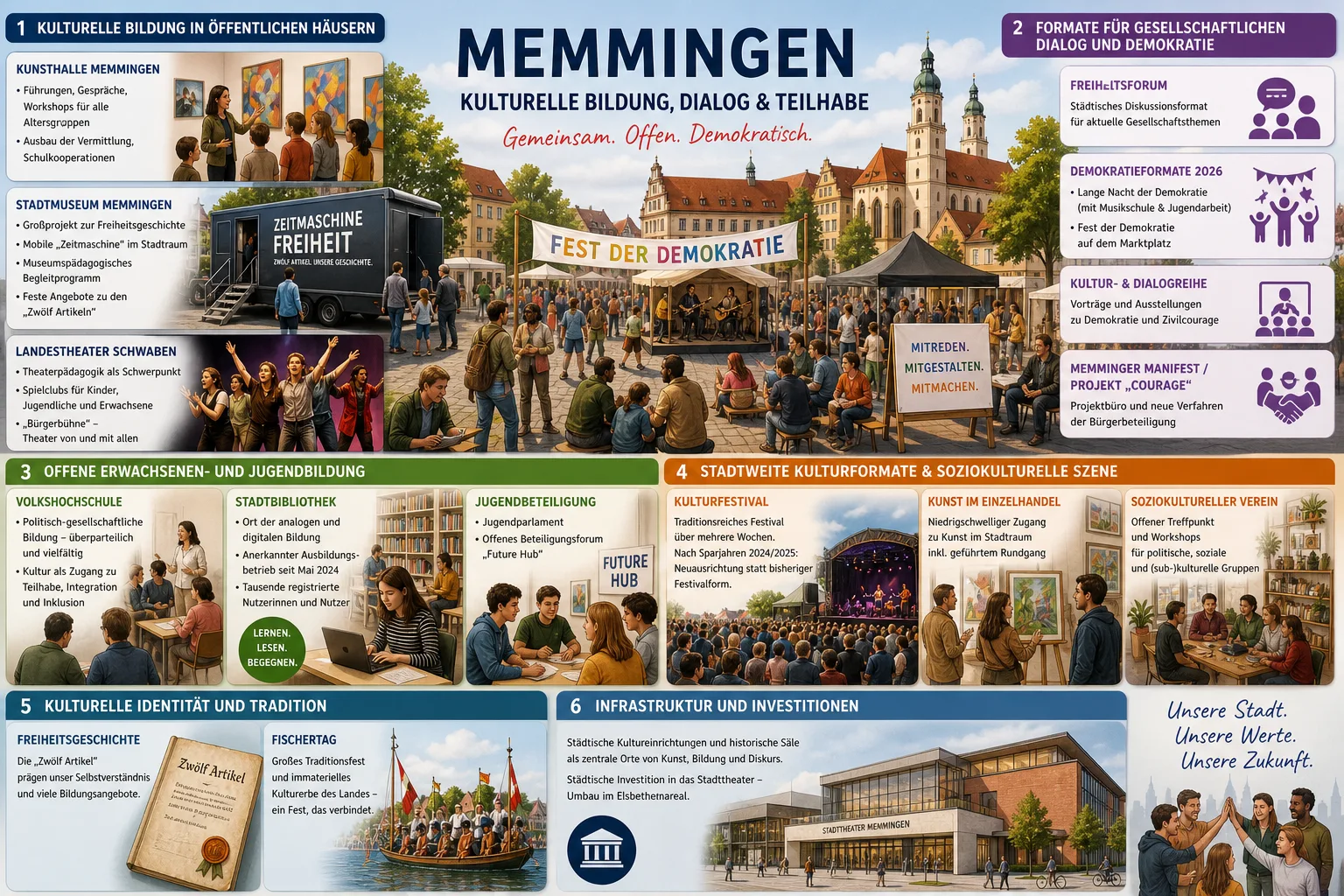
From 2027, Memmingen is likely to view cultural education in municipal institutions even more as public infrastructure: as an offering that not only "mediates," but also promotes encounters, dialogue skills, and orientation in everyday life. In practice, this means: more formats that start at a low threshold (without prior knowledge), but are content-rich (with context, moderation, and reflection).
Expansion of Mediation Formats in Exhibitions and Collections
In the coming years, the following will be particularly effective in municipal exhibition contexts: guided tours, workshop discussions with art and cultural education, as well as bookable school modules that connect to curricula without reverting to frontal teaching. A future focus can be on "dialogue formats" in which the audience not only listens but also makes their own perspectives visible (e.g., with voting stations, audio statements, or moderated small groups).
Theater Education as a Learning Space for Dialogue and Responsibility
From 2027, theater education offerings (e.g., play clubs, project groups, and civic stage formats) can be specifically expanded as "democracy competence training": listening, role-switching, conflict skills, and shared responsibility are practically rehearsed in the rehearsal process. Future series can be particularly well linked with thematic guiding questions (e.g., cohesion, intergenerational dialogue, belonging).
History of Freedom as a Topic for Future City Dialogue
For 2027 and the following years, it makes sense for Memmingen to continue using its history of freedom as an anchor for contemporary issues – but not as a backward-looking narrative, rather as a starting point for future discussion and educational formats: What does freedom mean today? How does local participation succeed? Where is civil courage needed?
Citywide Discussion Series with Clear Conversation Culture
In the coming years, city-bundled discussion formats (e.g., under a forum or series title) can be particularly effective if they meet three quality criteria:
- Transparent goals: Classification, diversity of perspectives, concrete next steps (e.g., recommendations or project ideas).
- Moderation and rules: Respectful debate, fact-checks within the format, clear speaking times.
- Low-barrier participation: Free or low-cost access, hybrid participation options, clear language.
Mobile Formats in Urban Space (from 2027)
Mobile "dialogue stations" in public spaces can become a central building block from 2027 to reach people who rarely attend lectures or panels. Future deployments on central squares, at weekly markets, or at neighborhood events can be designed to enable spontaneous conversations but also build a bridge to more in-depth events (e.g., through moderated follow-up evenings).
Adult Education, Youth Participation, and City Library: Next Development Steps
Adult Education: Orientation and Media Literacy as Future Topics
From 2027, adult education in many cities will be even more shaped by two topics: orientation in times of crisis and change, as well as media and information literacy. For Memmingen, this likely means: more lectures and course offerings that practically convey democratic core principles, communication culture, and dealing with disinformation – ideally non-partisan and dialogue-oriented.
City Library: Further Developing a Place for Learning and Encounters
In the coming years, the city library as a non-commercial place offers special opportunities: reading promotion, quiet learning zones, digital basic education, and curated information offerings can be tailored to life phases (school, training, work, further education). In the future, event formats such as "Ask the Library" consultation hours or themed evenings on information literacy can help strengthen trust in source work and factual debate.
Youth Participation: Formats that Create Real Impact
For 2027–2029, youth formats are particularly attractive when they not only collect ideas but also provide clear feedback: What was adopted, what was not – and why? Future participation formats (e.g., youth committees, project workshops, or thematic hubs) can be linked with cultural projects: theater or media projects that make youth topics visible, followed by structured discussions with administration and local politics.
Urban Space & New Cultural Formats: What Will Be Possible in the Coming Years
From 2027, cultural education in Memmingen can become even more visible in everyday life – in shop windows, temporary exhibition spaces, on squares, and in cooperation with businesses, clubs, and initiatives. Such formats lower barriers (no admission, no threshold anxiety) and at the same time open up new opportunities for conversation.
Low-Threshold Art and Culture Trails
For future city center trails, curated routes are suitable that combine art and cultural contributions with moderated short formats: 15-minute conversations, "Meet the Artist" appointments, or audio guides with local voices. The goal for 2027–2029 can be to establish culture not as a special event, but as a recurring city experience.
Socio-Cultural Venues as "Laboratories" for New Topics
In the next few years, socio-cultural meeting points and open houses can take on a stronger role as experimental spaces: workshops, discussion evenings, project groups, and cooperation with schools or youth formats. Particularly future-proof are series that combine cultural practice and societal issues (e.g., music & intergenerational dialogue, creative workshop & sustainability, storytelling & diversity).
Cultural Infrastructure: Usability and Accessibility
For 2027 and beyond, the impact of cultural education will strongly depend on whether spaces are technically up-to-date and accessible. When developing venues and halls, the focus in the future will not only be on construction or technology, but also: How easily can schools, clubs, inclusive groups, and citizen initiatives use these places for their own formats?
Festivals, Values, Identity: Future Debates Around Tradition and Participation
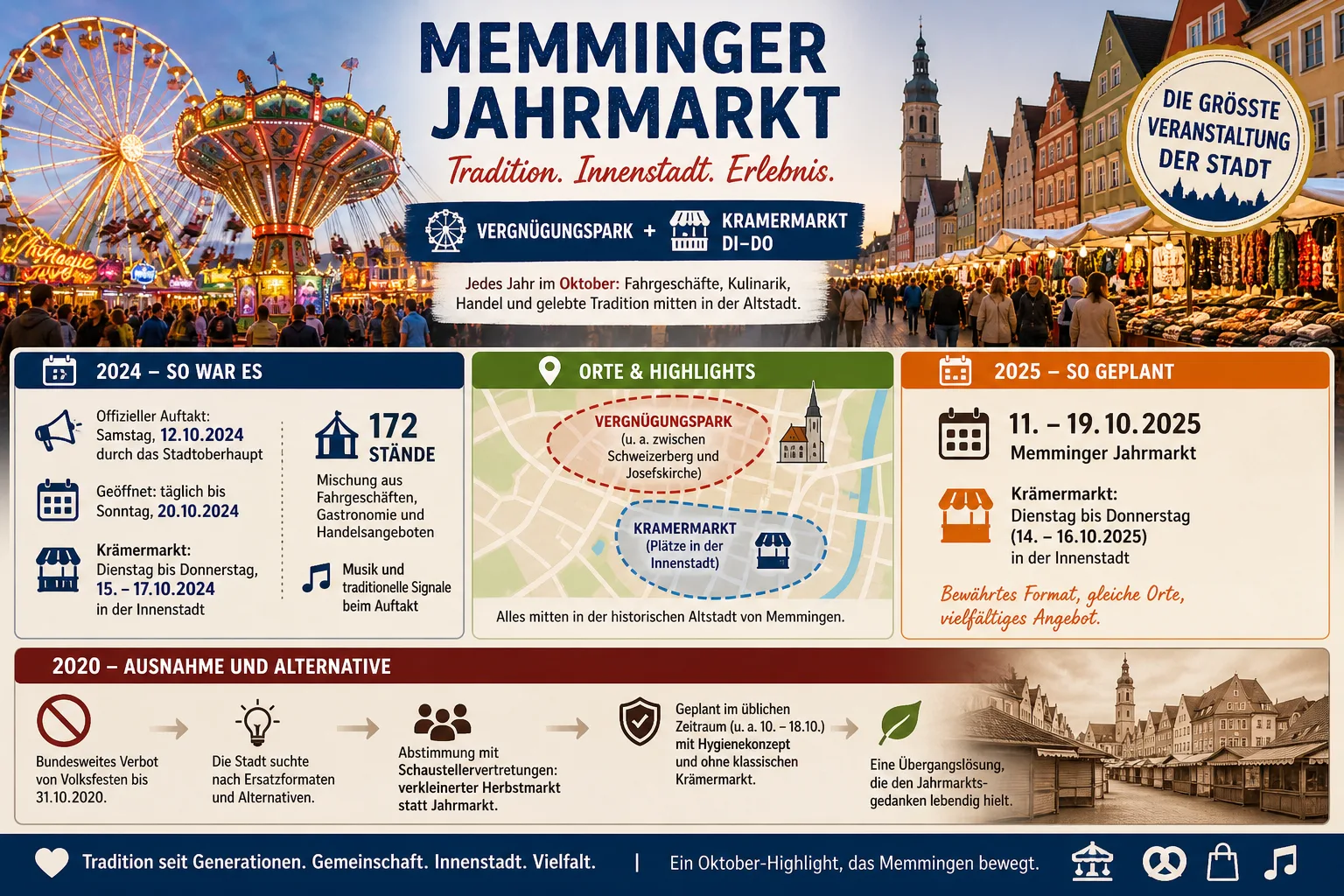
From 2027, the question will become more acute for Memmingen (as for many cities) of how traditional major events and urban identity can be reconciled with new expectations: sustainability, safety, inclusion, low-barrier access, and respectful celebration culture. This is precisely where cultural education can emerge – not as "instruction," but as joint reflection on rules, rituals, and coexistence.
Future-proof accompanying formats can be: public dialogue rounds in advance, exhibitions or media projects on the "culture of celebration," as well as moderated feedback formats after events. In this way, tradition in the coming years will not only be repeated, but further developed – with more transparency, more participation, and more learning opportunities for the urban society.
Outlook 2027–2029: Collaboration, Impact, Orientation
If Memmingen wants to further strengthen cultural education and societal discourse in the years 2027 to 2029, cooperation will be crucial: between cultural institutions, adult education, schools, youth formats, the library, and socio-cultural actors. Particularly effective are future "educational pathways" that do not consist of individual events, but of consecutive stations (e.g., workshop → exhibition/performance → moderated discussion → participation format).
This can create a clear added value for citizens: those who want to participate will find it easier to get started; those who want information will get classifying formats; and those who want to experience culture can experience it as a living part of a democratic city. What remains crucial: good moderation, comprehensible goals, fair access – and the willingness to endure and productively use different perspectives.
Note on Classification
This article describes exclusively future development directions and possible configurations from 2027 onwards. Concrete dates, program titles, and responsibilities are determined by the official publications of the city of Memmingen and the participating institutions.
Sources
- German UNESCO Commission: Intangible Cultural Heritage — Overview of goals and classification of lived cultural practices (accessed 2026-11-11)
- kubi-online: Platform for Cultural Education — Specialist articles and basics on cultural education in Germany (accessed 2026-11-11)
- Federal Agency for Civic Education (bpb) — Background material and concepts on civic education and discourse formats (accessed 2026-11-11)
- Museum and Mediation Practice (general) — Guidance on mediation approaches; for local programs, the official announcements of Memmingen institutions are decisive (accessed 2026-11-11)