Discover Spiritual Places & Meditation in Memmingen
Spiritual Places & Meditation in Memmingen: Your Quiet Timeout (with Ideas for the Coming Weeks)
Right in the middle of Memmingen, it can be surprisingly easy to shift into a calmer perception: a conscious walk instead of "just rushing through," a few minutes of breath focus instead of constant input. This guide compiles places, formats, and approaches you can try in the coming days and weeks—from quiet greenery to guided group offerings.
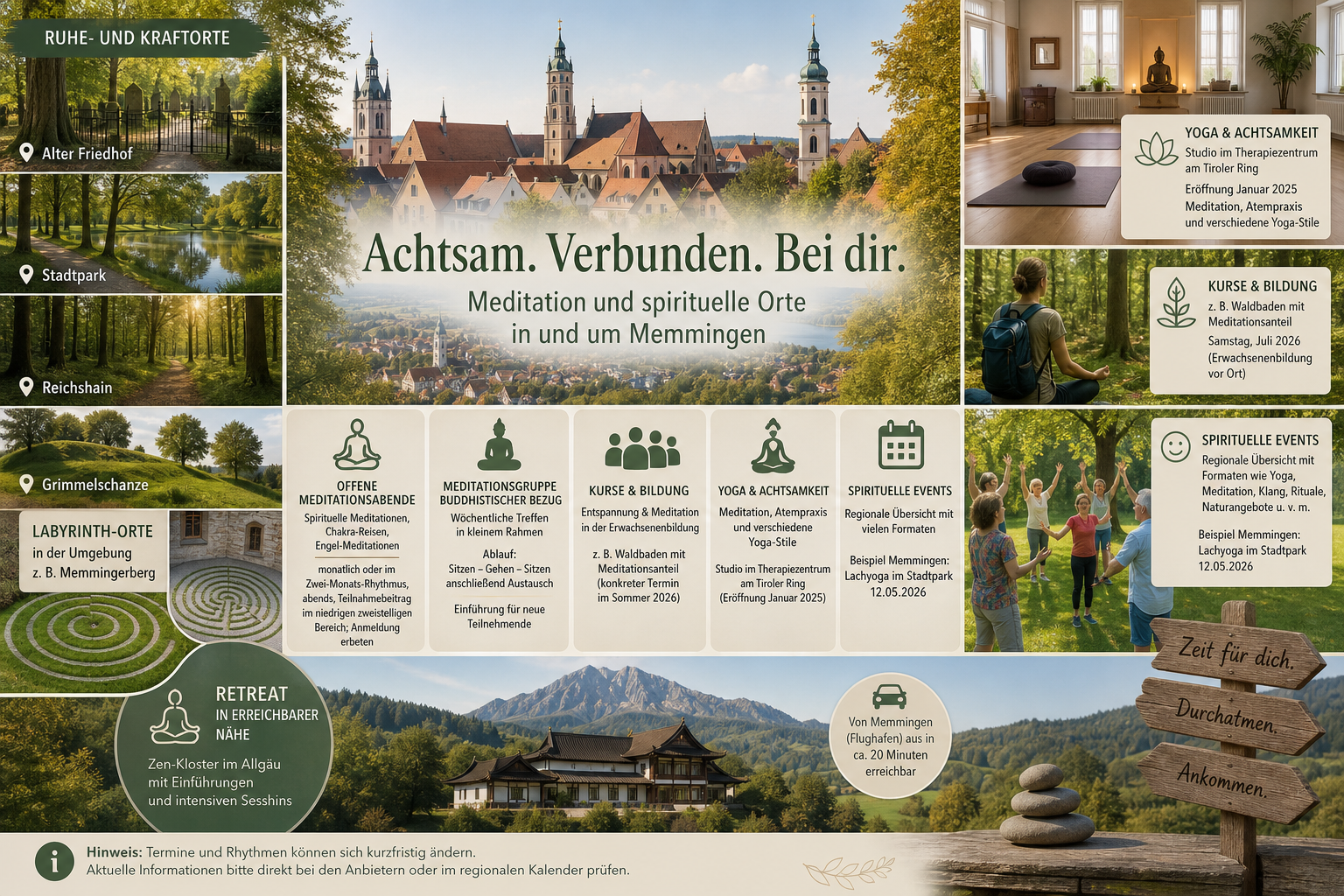
Places of Peace and Power in Memmingen: Silence in the Middle of the City
If you are specifically seeking peace in Memmingen in the coming weeks, it is worth choosing places that combine two qualities: predictability (you know what to expect) and low stimulation (less noise, less "to-do" feeling). The following spots are especially suitable for short, realistic timeouts of 5 to 30 minutes.
Old Cemetery: Walking Meditation Instead of Racing Thoughts
A cemetery is experienced by many people as a quiet place because pace, volume, and behavior are naturally subdued there. If you want to walk meditatively here, try this simple structure for your next visit:
- Arrive (1 minute): Silence your phone, relax your shoulders, take one conscious exhale.
- Walking (5–15 minutes): Step by step—feel the contact of your feet with the ground. If thoughts come, gently return to the next step.
- Conclusion (30 seconds): Stand still briefly, soften your gaze, a sentence like "For now, that's enough."
Important: Follow local rules (quiet, paths, opening hours) and respect mourners.
City Park & Reichshain: Mindfulness in Green Spaces, Without Preparation
For many, a park is the lowest entry barrier: you don't need to register, no experience, and no special equipment. For your upcoming walks, this mini-exercise can help:
- "5–4–3–2–1" (3 minutes): Silently name 5 things you see, 4 things you hear, 3 things you feel (e.g., wind, clothing), 2 things you smell, 1 thing you are grateful for right now.
This often works well because it deliberately shifts attention from rumination back to sensory perception.
Grimmelschanze & Elevated Viewpoints: Expansiveness as a "Reset"
Places with some expanse (view, sky, forest edge) are suitable for a particularly simple practice: "Gaze Meditation". Plan 5–10 minutes for your next visit:
- Stand stably or sit down.
- Don't focus your gaze on details, but "widely" into the scene.
- Breathe calmly and observe how your body settles a bit more with each exhale.
This form is suitable for everyday life because it requires no complicated technique—and still noticeably slows you down.
Labyrinth & Mindful Walking: A Path Inward (Without "Having to Sit")
A walkable labyrinth is not a maze. There is a clear path to the center and back out—with turns that occupy the mind but do not overwhelm. For people who (still) find silent sitting difficult, this can be a particularly suitable form of meditation in the coming weeks.
How to Walk a Labyrinth Meditatively (10–30 Minutes)
- Set an intention: A short sentence is enough, e.g., "I walk to become calmer" or "I bring a question with me".
- Way in: Walk slowly. If you get distracted, return to the feeling of your feet on the ground.
- Center: Stand still for 3–10 breaths. No pressure to "experience something".
- Way out: Notice if your pace, thoughts, or breath have changed.
- Integration: Afterwards, write down one sentence: "This is what I take with me into the day."
Forest Bathing as a Quiet Alternative for the Coming Weeks
Forest bathing (Shinrin-yoku) is not a sports program, but a slow, sensory form of time in nature. Especially during stressful phases, it can be helpful to schedule fixed mini-appointments for the coming weeks—for example, once a week for 30–60 minutes.
Typical elements are:
- slow walking without a set time goal,
- conscious smelling (forest air),
- listening (leaves, birdsong, wind),
- short breathing pauses.
Studies and reviews discuss that spending time in the forest may be associated with stress reduction and improved well-being. This does not replace medical treatment, but can be an effective addition to everyday life (see sources).
Meditation in Memmingen: Groups, Sound and Gentle Rituals
If you want to stick with it in the coming months, a group often helps: fixed appointment, clear guidance, less "I'm doing it wrong" feeling. In Memmingen and the surrounding area, various formats are regularly announced—from silent practice to sound- or movement-oriented evenings.
Guided Meditation Evenings (e.g., Visualization, Chakra Journey, Sound)
Evenings with guidance and a clear structure are usually beginner-friendly: arrival, short introduction, guided meditation, possibly sound (e.g., drum, singing bowl), closing round. For your planning:
- Check current dates: Times and locations can change at short notice.
- Ask questions: Duration, prior experience, what to bring (cushion/blanket), participation requirements.
- Clarify fit: If you are looking for more peace, choose quieter formats; if you need access through emotion, sound or visualization offerings may be more suitable.
Silent Practice in Structure: Sitting – Walking – Sitting
Many meditation groups (including those with Buddhist influences) use a simple, proven structure: several short sitting phases, with walking meditation in between. This is especially suitable for everyday life because it takes restlessness seriously: you don't have to "endure," but practice switching between stability (sitting) and regulation (walking).
If you are going for the first time soon, this focus helps: not "meditate perfectly," but get to know the process. That is often the most important step.
Movement-Based Formats (e.g., Laughter Yoga, Breath & Gentle Bodywork)
Some people only find access to silence through movement and shared activity. Regional event calendars regularly announce open formats that combine breath, voice, laughter, or gentle movement. If you are looking for something that immediately lifts your energy and regulates at the same time, a movement-based format could be a good entry point for your next weeks.
Yoga, Mindfulness and Breath: Paths to Depth
Yoga can be a bridge to meditation because it prepares the body: less tension, calmer breath, clearer perception. For many, this is the most realistic way to build a regular practice in the coming weeks—without pressure.
Yoga as a Bridge to Meditation (Practical Approach)
If you want to use yoga specifically as meditation preparation, pay less attention to "style names" when choosing a course and more to these criteria:
- Pace: rather calm to moderate (so the breath can lead).
- Breath cues: good teachers give clear, safe breath cues.
- Final relaxation/short silence: 5–10 minutes are often ideal for beginners.
- Suitability: clarify in advance in case of pain/illness and ask for options.
Mindfulness in Everyday Life: 4 Small Exercises for Memmingen (Starting Today)
- Breath pause (60 seconds): Stop, exhale longer than inhale (e.g., 4 seconds in, 6 seconds out).
- Walking meditation (10 minutes): In the park or on a quiet path: mentally say "left—right" to stabilize presence.
- Body scan in the evening (3 minutes): From forehead to feet: "Where is tension? Can I release 5%?"
- Gratitude (1 minute): Three concrete things from the day (small counts): "Sun on my face," "good conversation," "quiet moment."
Regularity beats intensity: better short daily than rarely "perfect."
Retreat and Meditation Journeys: Planning from Memmingen into the Allgäu
If you are seeking a deeper timeout in the coming months, a retreat can help: fewer decisions, clear times, more space for practice. Retreat formats are regularly announced around the Allgäu—from silent weekends to intensive meditation periods.
More Intensive Formats (e.g., Zen-Oriented Retreats/Sesshin)
Intensive retreats often include early rising, many meditation blocks, simple meals, and clear rules (e.g., periods of silence). This can be very supportive—and at the same time challenging. For your planning:
- Clarify introduction: Are there beginner options or introduction days?
- Health & strain: Sitting times, alternatives (chair), movement components.
- Everyday suitability: What do you take home (e.g., 10-minute routine)?
Gentle Entry: Day Seminars and Weekends
If you want to "get a taste of retreat air," day or weekend offerings are often ideal: you get structure and depth without blocking a whole week. When choosing, pay attention to clear information about leadership, program, costs, requirements, and cancellation conditions.
Practical Tips: How to Find Your Way in Memmingen
So that you really get into action in the next weeks, a simple plan helps instead of a long wish list:
- Choose 1 place + 1 exercise: e.g., city park + 10 minutes walking meditation.
- Set a fixed slot: e.g., Tuesday 12:30 or Sunday 9:00.
- Define "success" small: "I was there" instead of "I was completely silent in my head".
- If you try a group: Give yourself 2–3 sessions before deciding.
- Stay transparent with yourself: If you notice that silence triggers or overwhelms you, first choose movement/guided formats or talk to a professional.
Memmingen can be a good base for this: short distances, green spaces, quiet corners—and (depending on the schedule) announced offerings around meditation, yoga, sound, and time in nature.
Sources & Further Reading
- American Psychological Association (APA): Mindfulness — Overview of mindfulness and fields of application (accessed 2026-05-27)
- NCCIH (NIH): Meditation and Mindfulness—Effectiveness and Safety — evidence-based overview, benefits & safety aspects (accessed 2026-05-27)
- Frontiers in Psychology (2019): Effects of Forest Bathing (Shinrin-yoku) — scientific article on forest bathing and stress/well-being parameters (accessed 2026-05-27)
- The Labyrinth Society — background on labyrinth walking as a contemplative practice (accessed 2026-05-27)