Time Travel through Memmingen: Old Photos, Stories, People
Time Travel through Memmingen: Old Photos, Stories & People – Ideas for Upcoming Experiences
Would you like to experience Memmingen differently in the coming weeks or during your next stay – with historical images, narrated biographies, and places where history becomes visible? This page gathers suggestions for future walks, guided tours, and research: from the memory of 1525 to learning sites of the 20th century.
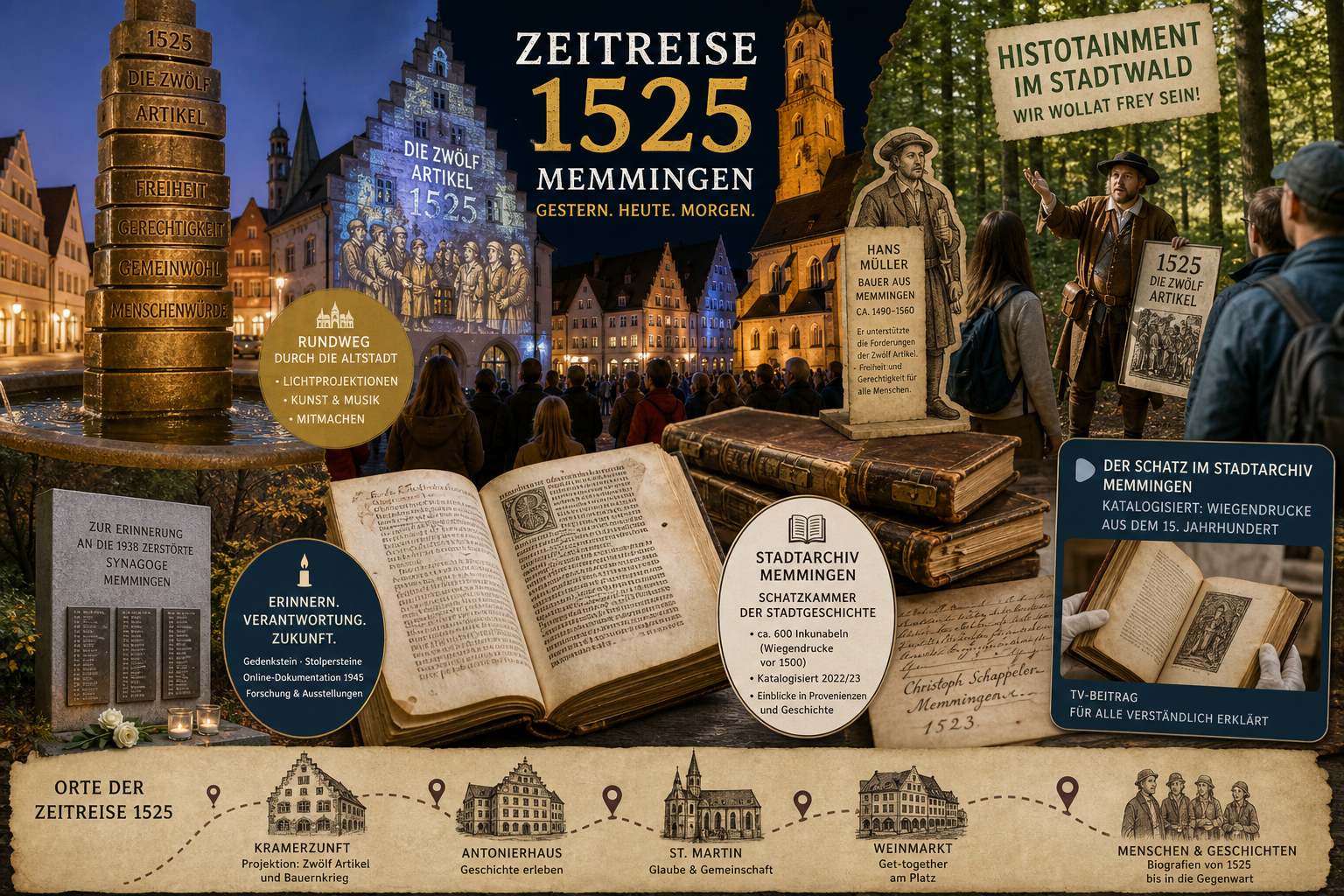
Route for Your Next Evening Walk
If you want to experience Memmingen in the future "as if through an old photo," a clear circular route helps: You go to well-known places, compare perspectives (today vs. historical images), and supplement the picture with short biographies and archival sources.
- Weinmarkt: Start here and make it your goal to consciously "read" the symbolism around freedom, rights, and city history (sculptures, plaques, inscriptions, urban design).
- St. Martin: Plan a stop to classify architecture and urban development (church spaces are often key places for everyday history, conflicts, and social order).
- Kramerzunft & Old Town Axes: Pay attention to traces of guilds and trade, which can be well connected with historical photos, maps, and house histories.
- Antonierhaus / Social Places: Focus on care, illness, community, and city administration as recurring themes in city history.
- Memorials in Urban Space: Take time for memorial sites, which are particularly impressive in future tours if you research names, dates, and life paths in advance.
If you are out with children or a group, a "two-level plan" is worthwhile: (1) short stops with clear questions, (2) deepen at home – with archival material, image comparisons, and maps.
Memmingen 1525: Twelve Articles as a Topic for Future Tours
A central focus for future visits to Memmingen can be the year 1525: In this context, the Twelve Articles are often discussed as an early document of social and legal demands in Europe. For an upcoming time travel, it is advisable to explore this topic not abstractly, but tied to specific places: Which locations are suitable for talking about conflicts, participation, and "rules of coexistence"?
This is how you make the topic tangible on site
- Read places as "chapters": Plan stops so that each stands for a topic (e.g., market & supply, church & value system, guilds & work, council & power).
- Work with short biographies: Choose a group of people for each stop (e.g., crafts, peasantry, clergy, city administration) and connect them with a guiding question.
- Combine text & image: Plan to read an understandable introduction to the Twelve Articles during preparation and specifically look for traces of the then city structure on site.
Important for a reliable presentation: When preparing, use primary or institutionally verified secondary sources as much as possible (e.g., museum texts, archives, academic introductions) and clearly separate proven facts from interpretations.
City Archive Memmingen: How to Plan Your Next Source Visit
If you want to delve deeper during your next stay, a visit to the City Archive Memmingen (or using its information services) is a sensible step. Archives are especially valuable because they provide documents, photos, maps, and finding aids that you need for reliable reconstructions.
Preparation: To Make Your Archive Appointment a Success
- Define your question: "Which street is in the photo?", "Which people are documented?", "How has a place changed?" – a clear question saves time.
- Note signatures/collections: If finding aids or online hints are available, note relevant collections in advance (photo archives, council minutes, maps, chronicles).
- Plan for usage rules: Inform yourself before the visit about registration, opening hours, reproduction options, and protection periods.
What you can aim for as a result
- A small image comparison (historical image + today's perspective).
- A short source protocol (title/collection, date, context, what is reliably documented).
- A mini-biography (if sources allow) – with clear labeling of what is documented and what is only plausible.
This way, "old photos" become a comprehensible story that you can later responsibly share in a blog, a family project, or a neighborhood group.
Guided Tours & "Histotainment": How to Find Suitable Dates
For an upcoming time travel through Memmingen, you can combine classic city tours with scenic formats. This is especially suitable if you not only want to "know" history, but also experience it along paths, dialogues, and places.
Which formats can complement each other well in the future
- Classic old town tour: Good for reliably understanding the basic structure (layers of time, important buildings, urban development).
- Themed tour (e.g., Reformation, trade, crafts, culture of remembrance): Good for deepening individual eras or lines of conflict.
- Scenic tour / role formats: Good for making biographies, dilemmas, and the language of a time tangible – best when the guide transparently shows what is historically documented.
- Nature and city edge routes (e.g., towards the city forest): Good for incorporating everyday life, supply, and movement spaces outside the old town into the narrative.
For concrete scheduling, it is worthwhile to check the official event calendars and provider pages of the city or the tourism information in the future. This ensures that times, meeting points, and topics are up to date.
Old Photos & Memorial Sites: Ideas for Your Next Research Path
If you want to explore Memmingen through images in the future, a mix of photo work and memorial sites is particularly effective: Photos show change, memorial signs give names and moral orientation.
A Good Procedure for Upcoming Projects
- Choose a motif: Square, street, school, business, club life, or a family occasion.
- Secure image data: Photographer, year, source, rights, captions (everything that enables classification later).
- Visit the place: If possible, retake the perspective and note what has changed.
- Add context: Look for a map, newspaper report, administrative document, or eyewitness account (if available) – ideally through institutional collections.
- Consider the memorial dimension: If the motif is linked to persecution, violence, or discrimination, work especially carefully: no dramatization, no speculation, clear source situation.
This way, a photo becomes not mere nostalgia, but a verifiable building block for city history – suitable for educational work, exhibitions, lectures, or digital city routes that you may want to create in the future (e.g., with a school class or an initiative).
People at the Center: Biographies as a Bridge for Future Projects
Biographies are one of the best methods to make a time travel understandable in the future: Instead of "the city" or "the era," concrete people speak – with roles, possibilities, constraints, and decisions.
This is how you responsibly build future biography stations
- Only documented information: Name, life dates, profession/status, documented events – and the source in each case.
- Context instead of speculation: If something is unclear, rather explain the framework conditions (e.g., city regulations, guild system, war situation) instead of inventing motives.
- Multiple perspectives: Plan several perspectives (e.g., city decision-makers, crafts, rural actors, religious authorities, those affected by exclusion).
- Choose language carefully: Especially in the history of violence and persecution: precise, respectful, without sensationalism.
This way, you can design future tours, lessons, neighborhood evenings, or digital story maps that are informative and at the same time remain empathetic.
Practical Tips for Your Time Travel (Planning)
- Set a time frame: For a first impression, 90–120 minutes in the old town are enough; for photo and archive work, plan additional time the next day.
- Pre-reading: Read a short introduction to the Twelve Articles and a reputable city chronicle/archive page so you can better classify places.
- Photo set: Smartphone + note app is sufficient; additionally helpful are printouts/scans of historical motifs (with source information).
- Barrier-free route: If you are planning with a stroller or mobility restriction, choose a route with as few steps and short distances as possible.
- Respect at memorial sites: Consciously plan quiet minutes; read names and texts in full; only take photos if appropriate.
Sources & Further Links
- Federal Agency for Civic Education (bpb) — Background texts on history, political basic concepts, and historical classification (accessed 2026-05-20)
- House of Bavarian History — Materials and classifications on Bavarian history, eras, and source work (accessed 2026-05-20)
- Encyclopaedia Britannica — Overview articles as an introduction, suitable for clarifying terms and contextualization (accessed 2026-05-20)
- City of Memmingen (official portal) — Official information on the city, culture, contact points, and planning a future visit (accessed 2026-05-20)
Note on reliability: For specific names, dates, image rights, and detailed questions, institutional primary sources (archives, museums, official documentation) are decisive. Always check the original source before publication.